

Across Europe, the question is increasingly no longer whether research security matters, but how to make it work in practice without undermining the openness and international collaboration that research depends on. An INSPIRING ERA online event on 25 November 2026 explored how security risks can be managed in a proportionate and practical way across the research system.
How can research organisations identify and manage security risks while maintaining academic freedom and international cooperation? Who should be responsible for assessing those risks? And what support do researchers and institutions need to make difficult decisions in practice?
These questions were at the centre of Keeping European research open and secure: making research security work in practice, an INSPIRING ERA online event organised in collaboration with ALLEA.
The event brought together participants from across Europe, including representatives of universities and research organisations, funders, public authorities and policy organisations. The programme combined the European policy perspective with national, institutional and funder approaches, before a panel discussion explored some of the more difficult questions emerging as research security policies are put into practice.
From European policy to implementation
Opening the event, Mirko van Muijen from the European Commission’s Directorate-General for Research and Innovation outlined the European approach to research security and the progress made since the Council Recommendation on enhancing research security was adopted in May 2024.
At the heart of the European approach is the objective of keeping international research and innovation cooperation both open and secure. As Mirko van Muijen emphasised, these should not be seen as alternatives. Research security is intended to help protect the conditions that make open international cooperation possible.
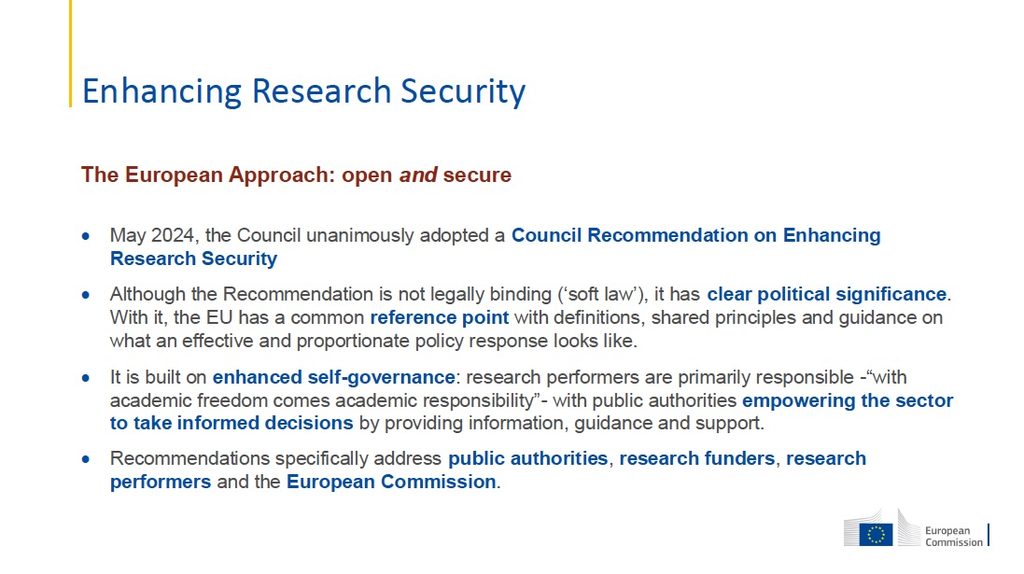
The Council Recommendation provides a common European reference point while placing significant responsibility on the research sector itself. Research organisations are expected to develop appropriate risk assessment and due diligence procedures, build internal expertise and provide researchers with guidance and support. Public authorities, meanwhile, have an important role in providing information about threats and risks, facilitating access to expertise and creating national support structures.
Implementation is developing quickly, but unevenly. The European Commission’s first Research Security Monitor, published in 2026, shows considerable activity across Europe, while also revealing differences between and within countries in the maturity of research-security systems.
Several new EU-level support measures are now being developed. These include a European Centre of Expertise on Research Security, intended to strengthen the evidence base and build a European community of practice, and an online due-diligence tool designed to help institutions access information needed when assessing potential international partners.
Questions from participants highlighted the practical importance of these developments. Mirko van Muijen confirmed that the EU approach remains country-agnostic at policy level: policies should not automatically target particular countries, although the country, institution, research area and other factors may all be relevant when assessing the risks associated with a particular collaboration. He also stressed that cooperation with like-minded partners outside the EU would continue to be important as European support structures develop.
Navigating grey areas
While the European framework is becoming clearer, many of the most difficult decisions remain context-dependent.
Andrew James, Professor of Innovation Management and Policy at the University of Manchester, highlighted a series of challenges that Europe now needs to address as research security moves further into implementation.
One is the need for a stronger evidence base. Research-security policies have often developed in response to particular incidents or perceived threats, but more systematic evidence is needed about which approaches work, how measures affect researcher behaviour and which practices can be transferred between different institutional and national contexts.
Another challenge is coherence. Countries and institutions are at very different stages in developing research-security policies and capabilities. Greater European coordination and exchange of good practice could reduce unnecessary duplication and help institutions collaborate with greater confidence, while still allowing approaches to reflect different national and institutional circumstances.
Implementation also requires resources. Policies need people with appropriate expertise, practical due-diligence tools, training, clear processes and trusted routes through which researchers can seek advice. This can be particularly challenging for smaller research organisations that may not have the capacity to develop specialist teams themselves.
Andrew James also stressed the importance of avoiding a “chilling effect”, where uncertainty, administrative burdens or fear of getting decisions wrong lead researchers to step away from legitimate international collaborations. Research security, he argued, needs to support informed judgement rather than simply introduce additional layers of compliance.
Three approaches to putting research security into practice
Examples from Spain, Czechia and Flanders demonstrated how these principles are being translated into practice at different levels of the research system.
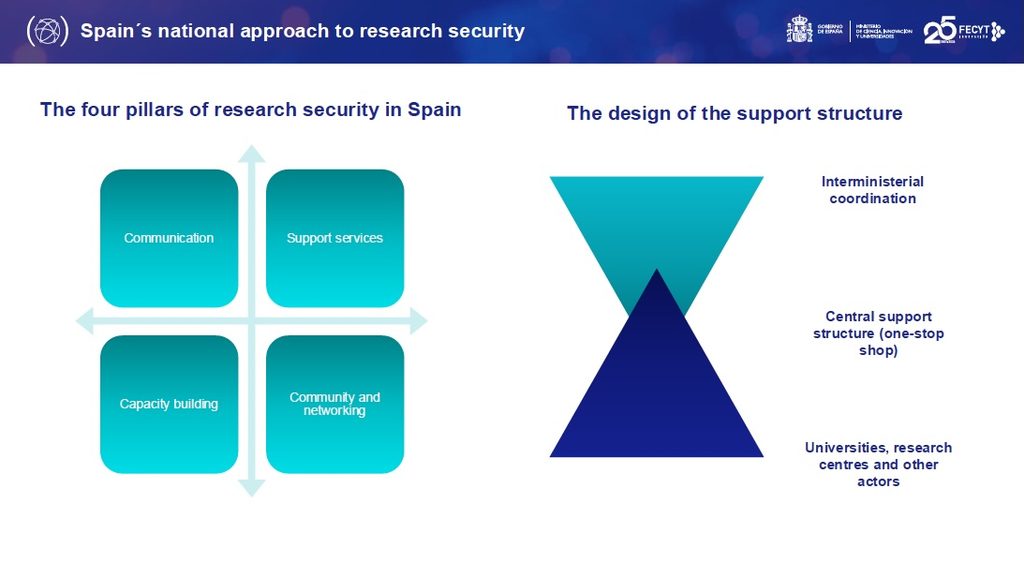
Gabriel Manuel Martín García from the Spanish Foundation for Science and Technology (FECYT) presented Spain’s developing national approach to research security. Following a mandate from the Ministry of Science, Innovation and Universities in 2025, Spain has established working groups bringing together research performers, funders and government ministries.
The emerging system is built around four pillars: communication, capacity building, support services, and community and networking. A central aim is to translate high-level European policy into practical guidance that researchers and institutions can use in their everyday work. Spain has already launched the Ciencia Segura national portal, while national guidelines and a central support structure or “one-stop shop” are planned as the approach moves into its next phase.
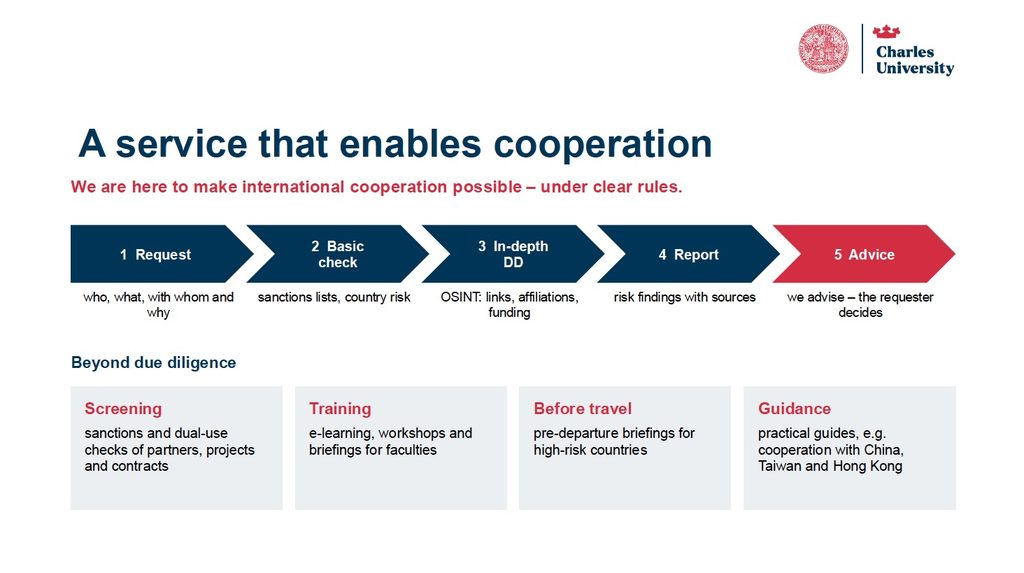
At institutional level, Valérie Hůrská described how Charles University in Czechia has developed a layered model for research security and institutional resilience.
Leadership commitment has been crucial. Responsibility is distributed between university leadership, a central team providing methodology, advice, due diligence and training, faculties and institutes carrying out initial assessments, and researchers and students themselves.
Importantly, Valérie Hůrská described the role of the central function as a service that enables cooperation, rather than as a policing function. Due diligence can range from basic screening to more detailed open-source investigation, but advice is intended to support informed decisions about how collaboration can proceed safely.
This institutional experience has also contributed to the development of the Czech RISC Platform – Research Integrity and Security Consortium – which connects universities and academies to share experience, methodologies and training. The example illustrated the potential value of pooling knowledge and capacity rather than expecting every institution to solve the same problems independently.
A third perspective came from Gregory Absillis of the Research Foundation Flanders (FWO), who demonstrated the role that research funders can play.
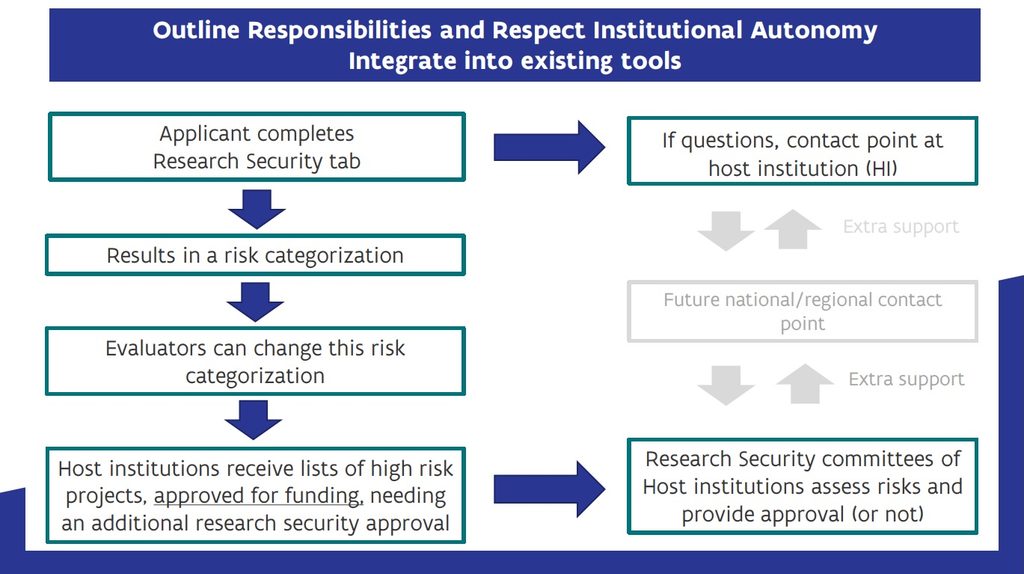
FWO has integrated a Research Security Appraisal tool directly into its funding application process. Rather than asking applicants simply to confirm that they have considered research security, the tool prompts them to reflect on different dimensions of risk relating to the research topic, countries, institutions and individual partners.
A key lesson has been the importance of co-creation. The system was developed together with Flemish universities, helping create shared ownership and ensuring that the tool could be used in practice. It has also been adjusted over successive funding rounds as FWO has gathered experience and evidence.
The funder does not take over institutional responsibility for research-security decisions. Instead, it provides a framework that encourages researchers to identify risks early, while host institutions retain responsibility for assessing higher-risk cases and deciding whether particular risks are acceptable.
Moving from compliance to culture
The final panel discussion, moderated by Daniel Kaiser, Deputy Director of ALLEA, brought together Mirko van Muijen from the European Commission, Tommy Shih from KTH Royal Institute of Technology and Lund University and Director of the Forum for Responsible Internationalization and Research Security, and Job Sommer from the Dutch National Contact Point for Knowledge Security.
The discussion focused on three closely connected themes: how to build a supportive research-security culture, what practical support researchers and institutions need, and what proportionality means in practice.
Culture and capacity formed the starting point. Tommy Shih highlighted the importance of involving researchers themselves in discussions about research security and giving them a sense of ownership of the issues involved. Building an effective research-security culture is not simply about increasing awareness of risks, but also about being clear about what security measures are intended to achieve and considering their possible effects on international mobility and collaboration.
The discussion also considered the risk of creating a culture of suspicion. Research security should not make international collaboration appear inherently problematic. From the perspective of the Dutch National Contact Point, Job Sommer described an approach that starts by examining the specific elements of a collaboration to identify where risks may arise, using risk indicators and reflection questions to guide the assessment. This allows mitigation measures to be targeted at particular concerns – for example, by clearly defining the scope of a research project and reviewing whether activities continue to remain within that scope – rather than treating the collaboration as a whole as inherently risky.
A second theme was practical support and responsibility. Universities and researchers cannot be expected to have access to all the information needed to assess complex geopolitical or security risks themselves. Mirko van Muijen emphasised the role of public authorities in providing reliable information and enabling research organisations to make informed decisions, while leaving significant responsibility with the research sector. Job Sommer also stressed that institutions differ in their structures and research profiles, meaning that support cannot rely on a single one-size-fits-all model.
The third major theme was proportionality. Job Sommer explained that difficult cases are best approached by breaking a collaboration down into its individual elements and identifying where specific risks lie. The Dutch system uses risk indicators and reflection questions to support this process, allowing mitigation measures to be targeted at the areas of greatest concern.
Tommy Shih raised a broader question: proportionality can only be judged if there is some clarity about the outcomes research-security measures are intended to achieve. Changes in international mobility and collaboration patterns underline the need to better understand both the intended and possible unintended effects of research-security measures.
An audience question took this further, asking whether overly restrictive approaches could themselves weaken Europe’s scientific capacity and international competitiveness.
Mirko van Muijen acknowledged the difficulty of assessing the effectiveness of policies designed to prevent harm. He argued for a stronger evidence base – both on the nature and scale of research-security threats and on which policy measures are most effective. While some situations may call for clear limits, many others remain grey areas where case-by-case assessment can support a more proportionate response.
Across the discussion, a common message emerged: effective research security should help researchers and institutions make better-informed decisions, not simply discourage collaboration. Achieving that will require trusted advice, better evidence, dialogue with the research community and continued cooperation between institutions, national authorities and European-level actors.
Supporting good decisions
Across the presentations and discussion, several common needs emerged.
Researchers and institutions need access to reliable information and specialist advice. Institutions need sufficient capacity to undertake proportionate risk assessments. Responsibilities between researchers, universities, funders and public authorities need to be clear. Greater exchange between institutions and countries can help avoid every organisation having to develop expertise independently.
At the same time, research-security systems need to remain adaptable. Risks, technologies and geopolitical circumstances change, and approaches will need to evolve with them.
Perhaps most importantly, participants repeatedly returned to the importance of dialogue. Research security involves difficult judgements for which there will not always be a simple rule or checklist.
A clear message from the event was therefore not to wait for every question to be resolved before engaging with the issue. Institutions and researchers should actively discuss research security, build the relationships and expertise needed to navigate difficult cases, and contribute to shaping approaches that protect research while allowing international collaboration to continue.
Explore the event materials and further resources
The speakers’ presentations and a collection of useful resources are available on the event materials page.
The event was organised by INSPIRING ERA in collaboration with ALLEA, supporting dialogue and exchange around implementation of the European Research Area Policy Agenda.