
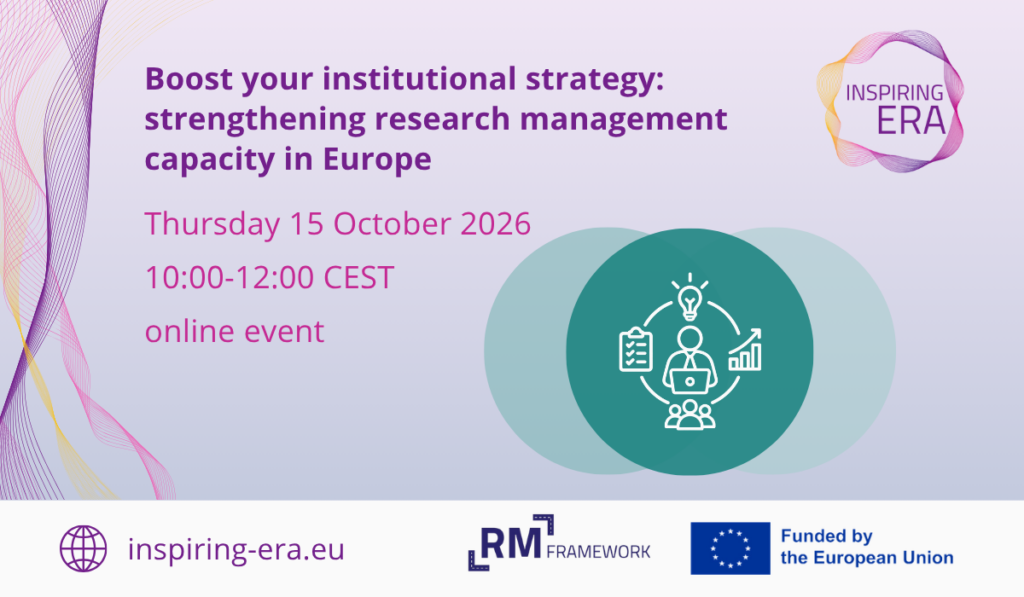
Research management is increasingly recognised as essential to institutional success, research quality and international competitiveness. An INSPIRING ERA online event on 15 October 2026 explored how European policies, professional development initiatives and institutional changes across Europe are helping to strengthen research management capacity and embed it more firmly in institutional strategy.
How can research organisations strengthen their capacity to compete internationally, support excellent research and respond to changing European priorities? An important part of the answer lies in recognising research management not simply as an administrative or support function, but as a strategic asset.
This was the central theme of Boost Your Institutional Strategy: Strengthening Research Management Capacity in Europe, an INSPIRING ERA online event organised in collaboration with the Horizon Europe-funded RM Framework project.
The event attracted considerable interest, with around 850 registrations from 44 countries and 490 participants joining the discussions. Aimed at research managers, institutional leaders, policymakers and research funding organisations, it explored how research management is being recognised, professionalised and strengthened at European, national and institutional levels.
Research management: A growing European policy priority
Opening the event, Magda de Carli from the European Commission’s Directorate-General for Research and Innovation highlighted the strategic importance of research managers in advancing the European Research Area (ERA).
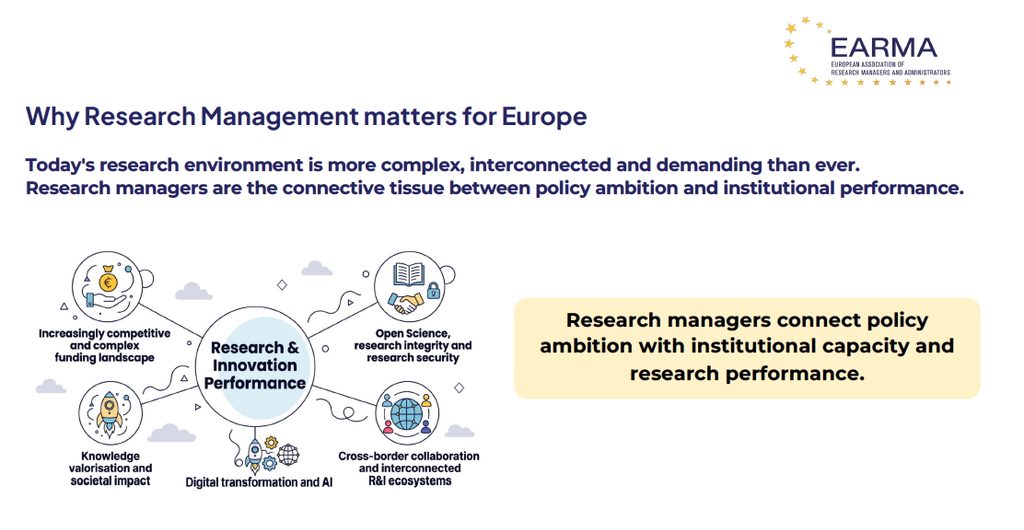
Working at the intersection of research, administration and institutional leadership, research managers connect people, funding, processes and strategies. Their contribution extends well beyond managing grants and projects to supporting institutional development, research excellence and the implementation of European research priorities.
This growing recognition is reflected in the ERA Policy Agenda 2025–2027, which includes an action dedicated to strengthening research management through recognition, upskilling, networking and capacity building.
De Carli highlighted the progress made through successive ERA actions, including the development of a common definition of research management, the European Competence Framework for Research Managers (RM Comp), training resources and professional networks. The current ERA action is supported by 23 EU Member States, six Associated Countries and 13 stakeholder organisations, demonstrating increasing European commitment to the profession.
From recognition to professional development
While policy recognition has advanced especially at the European level, an important challenge remains: how can research organisations translate European frameworks into practical opportunities for research managers?
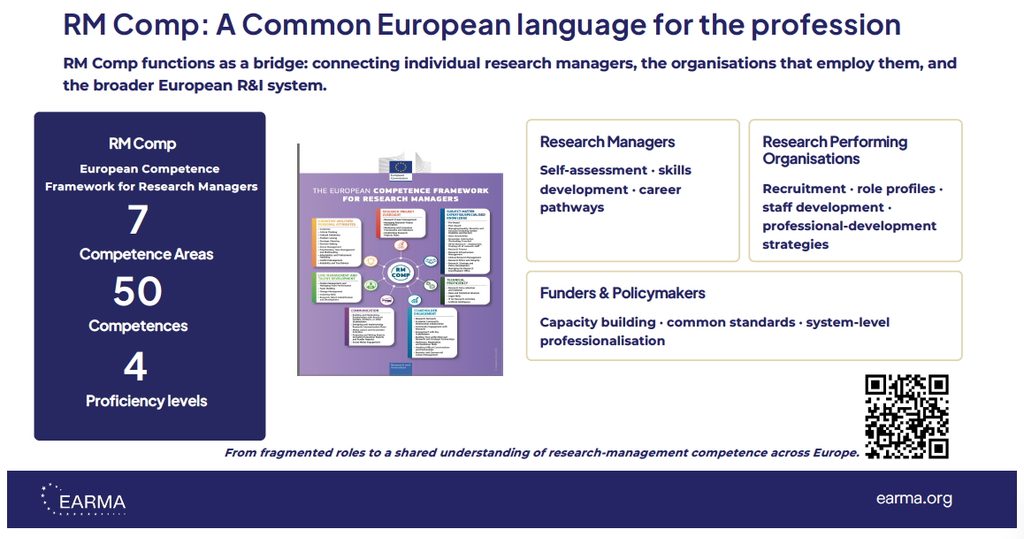
Teodora Konach from the European Association of Research Managers and Administrators (EARMA) presented European initiatives supporting this transition, including the RM Comp framework and the RM Framework project.
RM Comp provides a common reference for research management skills and competences, covering seven competence areas, 50 competences and four proficiency levels. It can help research managers assess their skills and plan their careers, while supporting institutions in developing job profiles, recruitment practices and professional development opportunities.
The RM Framework project is building on this foundation by developing a practical training handbook, a quality label concept and pilot activities to help organisations deliver high-quality, competence-based training.
Konach emphasised that European frameworks need to be adapted to different institutional contexts rather than imposing a single model. Professionalisation also requires sustained investment, recognition of research managers’ strategic contribution and clearer career pathways.
Building research management capacity: Lessons from Norway and Slovenia
Two national examples illustrated different approaches to developing research management capacity and the importance of long-term support.
Nichole Elgueta Silva from the University of Agder presented Norway’s NARMA Professional Development Programme, established in collaboration with the Research Council of Norway in 2017.
The programme offers training for research management professionals at different career stages, including introductory and advanced courses, leadership seminars and webinars. Beyond developing individual skills, it strengthens networks and encourages the exchange of knowledge and good practices between institutions.
An important lesson from the Norwegian experience is the need for long-term strategic commitment, dedicated coordination and continued collaboration between institutions and stakeholders to sustain professional development.
Maja Peharc from Slovenia’s Ministry of Education, Science and Youth presented how Slovenia has used funding from the EU’s Recovery and Resilience Facility to strengthen research management capacity in public research organisations.
The ministry launched a dedicated funding call to strengthen project offices, improve support for participation in European research programmes and encourage knowledge sharing between institutions. With more than €5 million allocated, the initiative supported four collaborative projects bringing together research organisations with different levels of experience. The projects have created new research management positions, delivered extensive training activities and strengthened cooperation across the national research community.
The experience demonstrated how targeted national investment can help build institutional capacity and professional networks, while also highlighting the importance of sustaining these developments beyond the initial funding period.
Embedding research management in institutional strategy
Examples from Sweden and Czechia demonstrated how research management can contribute directly to institutional leadership, quality development and organisational change.
At Lund University in Sweden, Carin Andersson, Head of Research Services, explained how research management has become an integral part of the university’s approach to strengthening research quality.
Research Services contributes to the development and implementation of an overarching research quality system, including structured dialogue between university management and faculties, the development of performance indicators and the analysis of research funding data.
Rather than focusing solely on operational support, research managers are helping inform institutional decision-making and identify opportunities for continuous improvement.
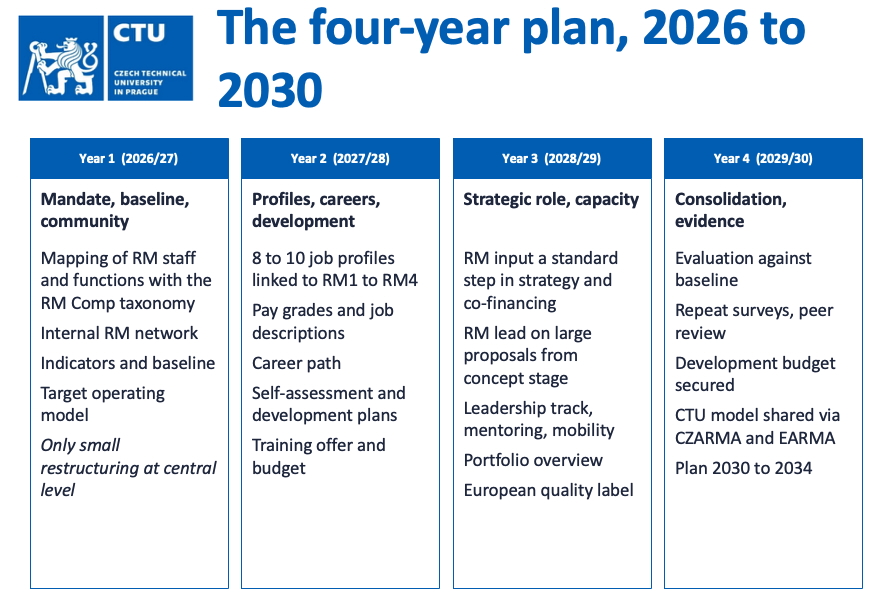
A second example came from Adéla Jiroudková at Czech Technical University in Prague, which is embarking on a four-year transformation to strengthen research management as a recognised strategic function.
The university has approved a plan for 2026–2030 that includes mapping research management roles, developing professional profiles and career pathways, strengthening staff development and systematically involving research managers in strategic processes.
The approach builds on existing European tools such as RM Comp, demonstrating how common European frameworks can be adapted to institutional needs.
Although the transformation is still at an early stage, the example illustrates the importance of leadership commitment, clear responsibilities and involving research managers in organisational change from the outset.
Moving from support function to strategic partner
A panel discussion moderated by Omar Cutajar from Xjenza Malta brought together perspectives from research institutions, funders and policymakers on how research management can become better recognised and embedded in institutional decision-making.
Natalia Dave Coll from the Centre for Genomic Regulation in Spain reflected on the value of research managers’ ability to connect scientific priorities with institutional strategy and funding opportunities, while Ignasi López Verdeguer from the “la Caixa” Foundation highlighted their contribution to linking research, institutions and society.
From an institutional leadership perspective, David M. Smith, Director of the Ruđer Bošković Institute in Croatia, shared how research management has evolved to support not only competitive funding and project implementation but also major strategic infrastructure development.
Zuzana Weisgärberová from Czechia’s Ministry of Education, Youth and Sports highlighted national initiatives to strengthen institutional capacity and the role of professional networks in developing skills and recognition.
Across the discussion, a common message emerged: research managers need opportunities to contribute to strategy, not simply to implement decisions made elsewhere.
Achieving this requires recognition from institutional leaders, clearer professional pathways, appropriate resources and closer collaboration between researchers, management teams, policymakers and funders.
From European ambition to institutional action
The event demonstrated how far research management has advanced as a European policy priority, with new frameworks, professional networks and capacity-building initiatives supporting its development across Europe.
Yet recognition alone is not enough. The experiences shared highlighted the importance of translating policy ambitions into lasting institutional change, including investing in professional skills, creating opportunities for career development and ensuring research managers can contribute meaningfully to strategic decisions.
As European research becomes increasingly competitive and interconnected, strengthening research management is not only an investment in a professional community. It is also an investment in the capacity of Europe’s research institutions to deliver excellent research and innovation.
Explore the event and further resources
Access the event recording and speakers’ presentations.
Further information and resources on research management, including forthcoming INSPIRING ERA publications highlighting challenges, success factors and good practices, will also be available through the project website.
The event was organised by INSPIRING ERA in collaboration with the Horizon Europe-funded RM Framework project, supporting the implementation of the European Research Area Policy Agenda.