
The European Open Science Cloud (EOSC) Federation is moving from development into operation, bringing together research data, tools and services across Europe. An INSPIRING ERA online event on 22 October 2026 explored the progress made so far, practical examples of the Federation in action, and the challenges and opportunities ahead.
Researchers increasingly need access to data, computing resources and specialist services beyond their own institutions, disciplines and national borders. The EOSC Federation aims to make this possible by connecting existing research infrastructures and services into a shared European ecosystem, supporting more open, collaborative and effective research.
Organised by INSPIRING ERA in collaboration with the EOSC Association, the online event Building the EOSC Federation: Progress, Practice and Lessons from Across Europe brought together European policymakers, research infrastructure representatives and researchers to explore how the Federation is taking shape and what it means in practice.
The discussions came at a significant moment: following the EOSC Symposium in Florence, the Federation had officially entered production, with its first group of interconnected nodes becoming operational.
A key priority for the European Research Area
Opening the event, Fabian Kreuzer from the European Commission’s Directorate-General for Research and Innovation placed EOSC within the broader European open science policy landscape.
He explained that making open science the norm is a central EU objective, helping to improve research efficiency, transparency, reproducibility and collaboration. EOSC plays an important role in achieving this ambition and is a key component of the ERA Policy Agenda 2025–2027, under the structural policy on enabling open science through the sharing and reuse of research data.
Kreuzer also highlighted EOSC’s growing strategic importance for Europe’s research and technology infrastructures, including its potential to support AI in science by making high-quality, reusable research data more widely available.
The EU has committed around €500 million through Horizon Europe to support EOSC-related developments, demonstrating the scale of investment behind this ambition.
From development to an operational federation
Klaus Tochtermann, President of the EOSC Association, outlined the progress made in building the Federation, describing it as a socio-technical infrastructure that depends as much on cooperation between organisations and research communities as on technology.
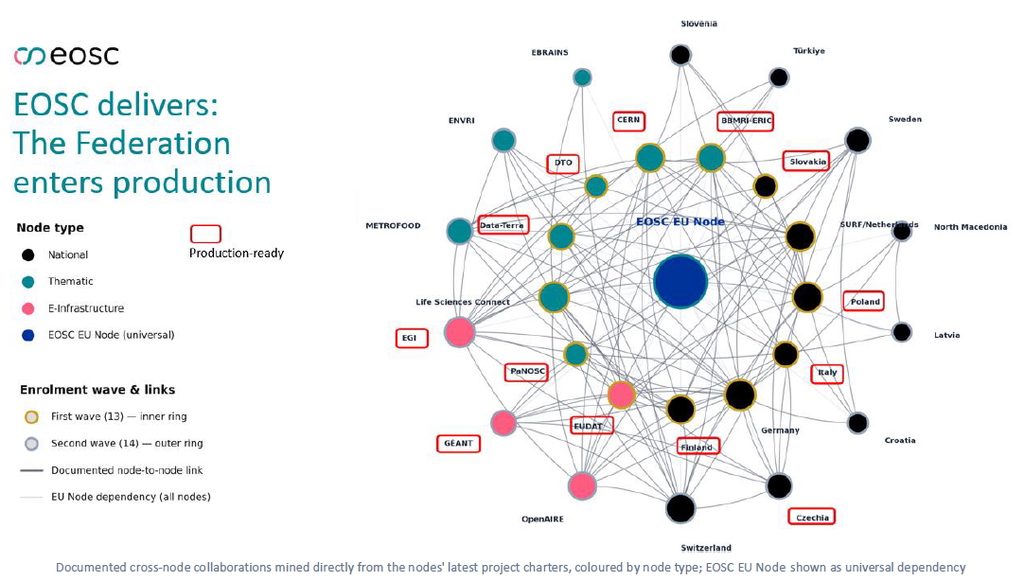
The Federation brings together 27 national, thematic and e-infrastructure nodes alongside the central EOSC EU Node. These connect existing resources and services while allowing participating organisations to retain responsibility for their own infrastructures.
An important milestone was reached in October 2026 when the first 14 nodes, including the EU Node, entered production. Work is continuing to strengthen interoperability, establish common standards and governance arrangements, and prepare additional nodes to join in 2027.
Tochtermann emphasised that building a Federation of this scale also requires addressing practical questions around cybersecurity, access conditions, service provision and long-term governance.
Different approaches to building EOSC nodes
Three presentations illustrated how the Federation operates at European, national and thematic levels, and how these different approaches complement one another.
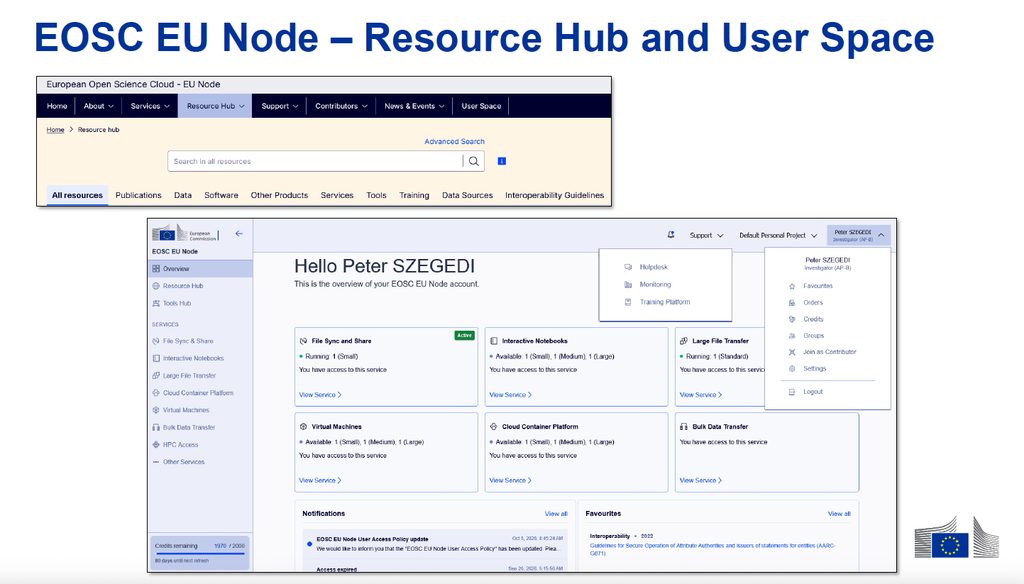
Peter Szegedi from the European Commission’s DG CONNECT introduced the EOSC EU Node, which serves both as a reference model for other nodes and as a central hub connecting the Federation.
Through its resource catalogue and user platform, researchers can discover research outputs and access services such as data storage, computing resources, file sharing and interactive analysis tools. The EU Node already provides access to information on more than 190 million research products and has over 6,000 registered users. It is also developing connections with other major European infrastructures, including EuroHPC and AI Factories.
At national level, Jessica Parland-von Essen from CSC – IT Center for Science presented the Finnish EOSC Node, illustrating how existing national research services can become part of a wider European ecosystem. Finland’s approach focuses on making services easier for researchers to discover and use, connecting national catalogues with the Federation and supporting research communities through shared standards and coordinated services.
A thematic perspective was provided by Peter Maccallum from ELIXIR, who introduced the Life Sciences Connect Node. Bringing together major European life science infrastructures, including ELIXIR, Euro-BioImaging, Instruct-ERIC and EMBL, the node connects a wide range of biological and biomedical data, tools and expertise.
Maccallum also shared lessons from integrating existing services into the Federation. While technical integration, particularly common authentication systems, presented challenges, the experience highlighted the importance of active collaboration between nodes and their involvement in developing shared governance arrangements.
Together, these examples demonstrated that the Federation is not about creating a single new infrastructure, but about connecting and building on Europe’s existing research capabilities.
What does the Federation mean for researchers?
Two research use cases demonstrated how the Federation can support collaboration across institutions and overcome barriers to accessing and analysing complex datasets.
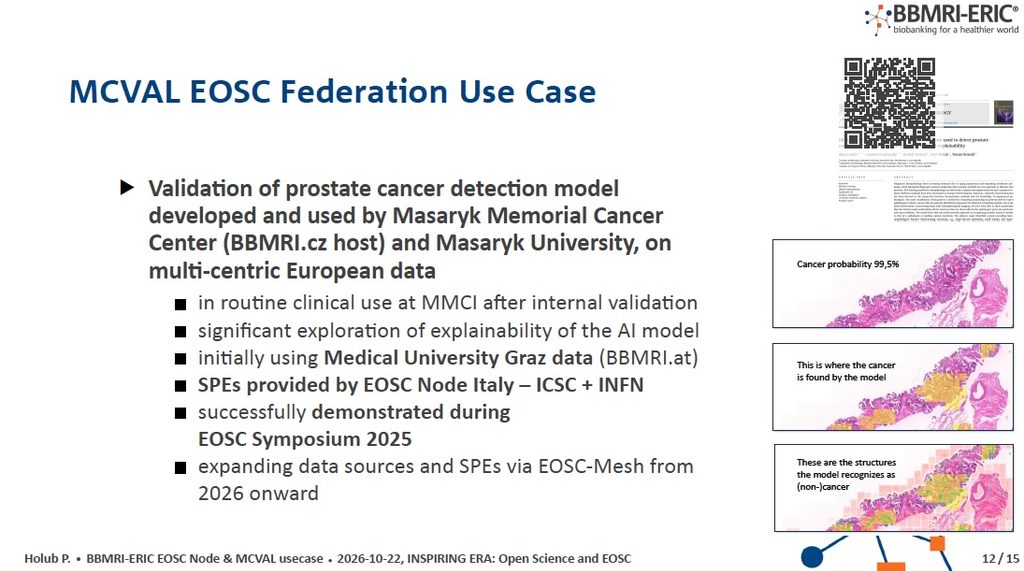
Petr Holub from BBMRI-ERIC presented a use case involving the validation of AI models for prostate cancer detection. The example showed how medical data from different European institutions can be used to test AI models through secure processing environments, while addressing the particular challenges associated with sensitive health data. (See an EOSC Association video about MCVAL here).
The work brings together expertise, data and computing capacities from multiple EOSC nodes, demonstrating how the Federation can support complex research workflows that would be difficult to achieve within a single institution.
A second example came from Cameron McClymont at CERN, who presented the REANA platform for reproducible research data analysis. Using data from the Large Hadron Collider, the demonstration showed how computing tasks can be distributed across six EOSC nodes, allowing researchers to analyse large datasets without having to move all the data between locations. (See an EOSC Association video about REANA here).
Although developed in particle physics, this approach has applications across other scientific disciplines that depend on large-scale data analysis.
Both examples illustrated the practical potential of the Federation while also highlighting the technical challenges involved in ensuring that different systems and services can work together effectively.
Making EOSC work for researchers: Lessons and challenges ahead
The event concluded with a panel discussion moderated by Pantelis Tziveloglou from the European Commission, bringing together Marie Jossé (CNRS/Data Terra), Aneta Pazik-Aybar (Polish National Science Centre) and Peter Sterle (Slovenian Ministry of Education, Science and Youth).
The discussion highlighted several priorities for the Federation’s next phase, including making research resources easier to discover, improving interoperability between services and simplifying the conditions under which data can be accessed and reused.
Participants also stressed the importance of trust in research data, particularly as AI becomes more widely used, and the need for clear information about data provenance, quality and permitted uses. Sustainable governance and continued collaboration between European, national and thematic infrastructures were identified as essential to the Federation’s long-term development.
Above all, the panel returned to the importance of putting researchers’ needs at the centre of EOSC.
Looking ahead, the panellists shared a vision of a Federation that becomes an integral part of everyday research practice, enabling researchers to find, access and use data and services seamlessly, without needing to understand the complex technical infrastructure behind them.
With the Federation now operational, attention is increasingly turning from building the infrastructure to ensuring that it delivers real value for Europe’s research communities.
Explore the event
Access the event recording and speakers’ presentations.
The event was organised by INSPIRING ERA in collaboration with the EOSC Association, supporting awareness and exchange on the implementation of the European Research Area Policy Agenda.