
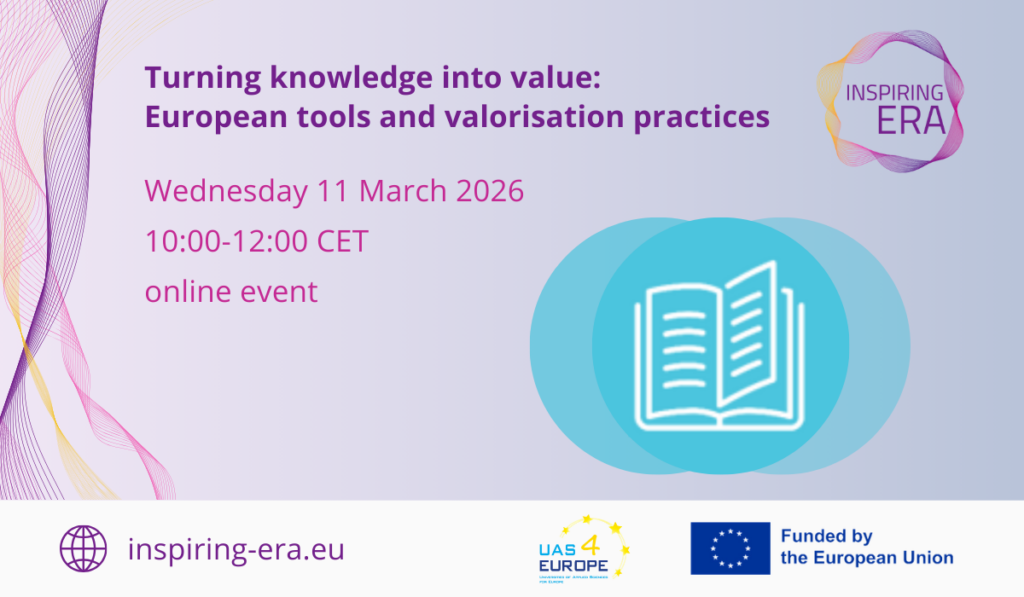
On 11 March 2026, the INSPIRING ERA project hosted an online event bringing together around 300 participants from across Europe to explore how knowledge valorisation can support the transition from research to real-world impact across Europe.
Organised in collaboration with UAS4EUROPE, the event focused on showcasing European tools, policy developments and practical experiences that support the implementation of knowledge valorisation across the European Research Area (ERA). Bringing together perspectives from the European Commission, support initiatives and practitioners across academia and industry, the event highlighted both progress made and the steps needed to embed knowledge valorisation more systematically in research and innovation systems.
European tools supporting the journey from research to impact
The opening session provided a practical overview of key European tools supporting knowledge valorisation. Szilvia Nemeth, Deputy Head of Unit, Knowledge Valorisation & Technology Infrastructures, DG Research and Innovation, European Commission, introduced the policy context, followed by Iiro Eerola, Policy Officer in the same unit, who presented concrete instruments and support structures.
These included the EU Knowledge Valorisation Platform, which provides access to best practices, funding opportunities and policy updates, as well as the Codes of Practice for Knowledge Valorisation, covering intellectual assets management, industry-academia co-creation, standardisation and citizen engagement. Together with the broader EU guiding principles and policy toolbox, these resources form a coherent framework to support researchers and organisations in turning knowledge into value.
Expanding pathways to impact in practice
The event showcased how knowledge valorisation takes many forms beyond traditional technology transfer, reflecting a broader understanding of how research creates value.
Manon Prado, European IP Helpdesk, presented how intellectual property can act as a strategic enabler of knowledge valorisation. She highlighted a shift towards proactive management of intellectual assets from early stages of research to support collaboration, reduce uncertainty and unlock investment opportunities. She also highlighted the support provided by the European IP Helpdesk — including training, practical templates and a free helpline — and illustrated through case studies how strategic IP management can support both collaboration and impact.
From an institutional perspective, Prof Dr Emanuele Carpanzano, Director of Research, Development and Knowledge Transfer at the University of Applied Sciences and Arts of Southern Switzerland (SUPSI), shared examples of industry-academia collaboration in practice. These included projects in sustainability, advanced manufacturing and AI, demonstrating how applied research contributes to innovation and competitiveness across different stages of the innovation chain. Together, these contributions illustrated the diversity of pathways through which knowledge valorisation can take place – from collaboration with industry and public actors to the development of services, technologies and solutions addressing societal challenges.
From ad hoc activities to strategic knowledge valorisation
The panel discussion brought together perspectives from across the ecosystem and was moderated by Elisabeth Hajicek, Programme Manager at the Austrian National Contact Point for Intellectual Assets and Knowledge Valorisation (NCP-IP) at the Austrian Research Promotion Agency, FFG.
Panellists included:
- Philippe Vanrie, Head of European Affairs and Brussels Representative at the University of Vaasa and Chair of the European Commission Mutual Learning Exercise on Knowledge Valorisation;
- Eduardo Beltrán de Nanclares, Innovation & Technology Director at MONDRAGON Corporation;
- Kathrin Metselaar, Impact Developer at Innovation eXchange Amsterdam (IXA).
The discussion focused on how knowledge valorisation can move from isolated or project-based activities towards a more strategic and embedded component of research and innovation systems.
Panellists emphasised that, despite growing recognition of its importance, knowledge valorisation is still often approached in a fragmented way. Philippe Vanrie highlighted that many organisations lack comprehensive strategies, while Eduardo Beltrán de Nanclares pointed to barriers such as misaligned incentives, fragmented innovation ecosystems and limited understanding of industry needs. Kathrin Metselaar underlined that knowledge valorisation is often treated as an additional burden for researchers, with limited time, skills or incentives to engage effectively.
Across all perspectives, a common message emerged: advancing knowledge valorisation requires more strategic approaches, earlier engagement and stronger alignment between research and its potential users.
Building a stronger knowledge valorisation ecosystem
A central message from the discussion was that turning knowledge into value requires coordinated action across the research and innovation ecosystem.
Panellists highlighted the importance of intermediaries, partnerships and support structures in connecting research with real-world needs. Strengthening skills, capacity and dedicated support mechanisms was seen as essential to enable researchers and organisations to engage more effectively in knowledge valorisation.
More broadly, the discussion pointed to the need for a cultural shift – recognising knowledge valorisation as a shared responsibility across stakeholders, supported by appropriate incentives, resources and collaboration frameworks.
From learning to action: participant reflections
Feedback from participants confirmed the event’s value in strengthening both understanding and practical application of knowledge valorisation. Participants particularly appreciated insights into European tools and concrete examples, as well as the combination of perspectives from policy, academia and industry. Many identified follow-up actions, including exploring funding opportunities, strengthening internal strategies, engaging with EU support services and developing new collaborations. At the same time, feedback highlighted the continued need for practical guidance and more diverse examples to support implementation across different contexts.
Resources now available
All event materials, including the event recording, presentation slides and additional links, are available on the INSPIRING ERA resource page.