
As Europe accelerates its green and digital transitions, R&I ecosystems are under increasing pressure to deliver solutions that are not only excellent, but also inclusive, transparent, and socially acceptable. The EU REINFORCING project addresses this challenge by supporting organisations, institutions and territories across Europe in embedding Open and Responsible Research and Innovation (ORRI) into their everyday practices.
REINFORCING promotes a shift towards a new R&I paradigm where responsibility and openness guide the entire the R&I process. The ORRI approach encourages early sharing of research outputs, collaboration across sectors, and the active involvement of citizens and stakeholders in co-design and co-creation. While widely recognised at the policy level, implementing ORRI in practice can be complex. Over the past decade, many tools, frameworks, and initiatives have emerged, yet these resources have often remained scattered and difficult to navigate. REINFORCING responds to this gap by offering a clear, structured, and accessible entry point for organisations at all stages of their ORRI journey.
Launched in October 2024, the REINFORCING ORRI Platform is an online space designed to make ORRI tangible and actionable. It brings together hundreds of curated resources, including funding opportunities, practical tools, training materials, and community connections, all in one place. The platform supports organisations that are just beginning to explore ORRI, as well as those looking to strengthen or scale up ORRI practices in their own organisation to institutionalise the ORRI approach.
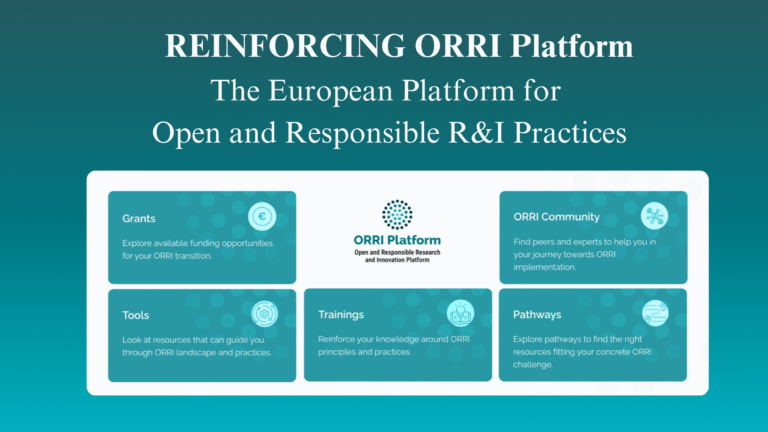
Its structure is organised around four complementary sections:
Grants. This section provides direct access to funding opportunities offered by REINFORCING. Users can explore current and past Open Calls, understand eligibility criteria, and consult the results of previous selections. The calls are designed to support organisations at different stages of maturity, from ORRI Incubators for first-time experiments to ORRI Boosters for scaling up the ORRI approach. Importantly, the grants combine financial support with learning materials and access to a wider community, helping beneficiaries move from experimentation to sustainable practice.
ORRI Community. The ORRI Community section connects organisations and local actors working on ORRI across Europe. A key feature is the ORRI Map, which allows users to see which institutions are active in ORRI, where they are located, and how to contact them. This section also showcases projects funded by REINFORCING, their activities and outputs, while highlighting related initiatives and networks that share similar goals. It offers a valuable space for peer learning, collaboration, and visibility.
Tools. With hundreds of resources available, the Tools section offers practical support for shaping and implementing ORRI actions. Resources range from detailed guides and case examples to short notes and methods that can be directly applied in organisational contexts. A flexible filtering system allows users to search by role, topic, or type of material, making it easy to find resources that match specific needs. Organisations are also invited to share their own ORRI tools or resources directly via the platform, contributing to a growing, collective knowledge base that benefits the wider community.
Training. The Training section provides access to learning sessions developed within REINFORCING, as well as materials created in collaboration with partner projects. These sessions help users build a solid understanding of ORRI concepts and explore how they can be applied in practice, whether at the project, organisational, or territorial level.
Recently, REINFORCING has published the policy brief “Embedding Openness and Responsibility in the next EU Framework Programme for Research and Innovation (FP10)”, which argues that ORRI is essential for a competitive FP10. In a context of economic pressure, rapid technological change, and growing societal expectations, the brief shows how openness can accelerate knowledge exchange, strengthen cross-sector collaboration, and speed up the uptake of innovation, while responsibility helps align research with real societal needs and European values.